Guide
Equipment covered in this guide
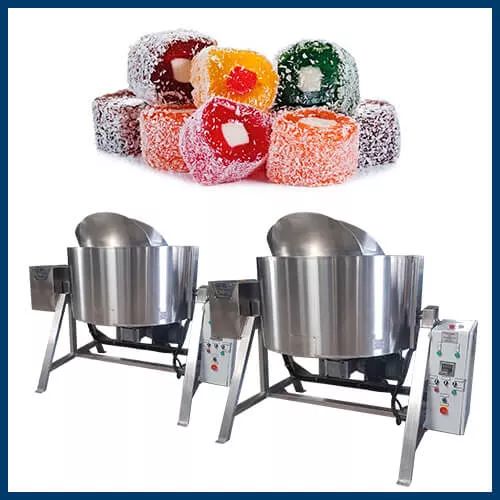
Turkish delight is a starch-and-sugar gel where the texture depends on a very specific cooking and gelling profile: water, sugar, glucose, and corn-starch slurry are cooked together, the mass is poured into starch-dusted trays or onto a starch belt, set, dusted again, and cut. Done in a continuous line, the cooking and depositing systems are synchronized to a fixed dosage and the gel sets uniformly enough to cut cleanly without crushing.
The variables that determine product quality are cooking temperature and time, starch concentration, gel set time, dusting humidity, and cutting geometry. A few degrees too high in the cook and the gel becomes sticky and short; too low and the cut surface tears. Starch dusting is its own discipline — too damp and the lokum sticks to itself in the box, too dry and the dust load in the room becomes a fire risk. A correct line treats starch handling as a separate engineering problem.
Two common buyer mistakes: ordering a single-flavour line for a multi-SKU plant (plain, nuts, rose, fruit purée) without a CIP-cleanable mass changeover, and skipping the cooling and aging step between gelling and cutting — the gel keeps relaxing for 12–24 hours, and cutting too early gives soft-sided cubes that deform in packaging.
Our approach is modular: stable cooking (vacuum or atmospheric), controlled starch dusting, set and aging tunnel, accurate cutting in two axes, AISI 304 stainless construction for hygiene and life. The layout can be expanded with packaging, cooling, and coating modules — but the first conversation is about your recipe set and daily volume, because the cooker and the depositing pumps are sized to that, not the other way around.
Guide